Knotweed (Reynoutria spp.) is a severely invasive plant originating from Eastern Asia. Introduced to the East Coast in the late 1800s as an ornamental, knotweed has since become ubiquitous across North America, reaching over 40 US states and 8 Canadian provinces. Knotweed has proven extremely detrimental to a wide variety of ecosystems in which it has established. Forming tall, dense thickets, knotweed shades out native plants, preventing them from growing. Additionally, knotweed is allelopathic, meaning it releases organic compounds into the soil that inhibits the growth of native plant species.
Knotweed also increases erosion along streams and riverbanks. By shading out native groundcover species and reducing the diverse root reinforcement provided by native species in riparian zones, riverbanks lose considerably more soil when infested with stands of knotweed (Hammer 2019, Matte et al. 2021). This erosion can increase turbidity of waterways, potentially affecting fish and other aquatic species (Henley et al. 2000). The reduction of native plants in riparian zones paired with winter dieback of knotweed stems also leaves riverbanks extremely vulnerable to winter and early spring flooding. This degradation of the riparian area creates a feedback loop in which floods carry knotweed propagules downstream, where they can colonize and increase erosion in new areas (Colleran et al. 2020).
Historically, management of knotweed has been extremely time-and-resource intensive. Large populations require years of consistent treatment, often combining mechanical and chemical approaches to be effective. This commitment to diligent, multi-year mechanical treatment can be discouraging and can lead many to abandon treatment plans before completion. However, a new knotweed management technique could reduce labor inputs.
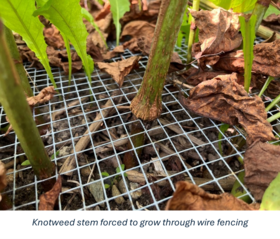
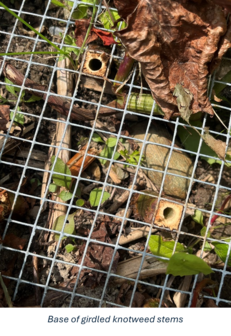
Developed by Dr. Eric Donnelly, the MeshTech management technique has produced promising results at managing the growth and spread of knotweed while dramatically reducing labor inputs. This method involves cutting knotweed stems down to the soil level and laying ½-inch galvanized steel hardware fencing over the cut stems. When knotweed resprouts, it grows through the openings in the fencing. As stems mature and thicken, the metal fencing will begin to cut into the stems.
The knotweed will continue to grow through the fencing, effectively girdling itself at its base. This method aims to impact knotweed’s nutrient pathways while also damaging the structural integrity of the plant. Alone, this method cannot eradicate knotweed populations. However, the MeshTech method can potentially reduce the health and vigor of knotweed, thus reducing the amount of cutting required in a growing season and the rate of spread in an area.
At the Pleasant Hill Preserve in Scarborough, the Scarborough Land Trust (SLT) has begun implementing the MeshTech method to manage a portion of their knotweed infestation. An effort led by SLT’s Stewardship Director Sami Wolf and Nathan Hjort, owner of Absolutely Complete Property Services, initial results indicate that the hardware fencing is proving successful. The knotweed forced to grow through the hardware fencing at Pleasant Hill Preserve showed clear signs of strain. Stems demonstrated significantly stunted growth and had even begun flowering early, an indication that a plant is under stress. While knotweed struggled to grow through the ½-inch holes, native flora had begun to sprout up through the hardware fencing. Other knotweed management practices, such as tarping or mowing, often discourage the growth of native species in a management area. Over time, the presence of native flora could provide an extra level of biotic resistance that could help slow the growth of knotweed and help kickstart native revegetation efforts. Eventually, supplemental plantings of native woody species can take place by cutting openings in the fence to allow for these larger species to grow. The fence can also be easily staked down, preventing knotweed or moving water from moving it out of place.
It is important to note that knotweed is a resilient plant and there is no single management action alone that will completely eliminate a population. The most effective knotweed management strategies use creative combinations of multiple approaches. Knotweed is a rhizomatous species, meaning it has an extensive, underground nutrient storage system made up of horizontal rhizomes that store nutrients. Draining this underground nutrient storage is the key to effectively managing an infestation. Consistent cutting of knotweed forces the plant to exhaust its below ground resources. By combining a cutting regimen with the MeshTech method, land managers could potentially see a significant reduction in their management timeline.
The effectiveness of this method provides promising implications for the future of knotweed management in Maine. Paired with consistent management, the MeshTech method could provide Maine with another tool to mitigate the spread of knotweed and reduce our reliance on chemical treatments.
Hammer, Chad F. “The impacts of terrestrial invasive plants on streams and natural and restored riparian forests in Northern New England.” Master’s thesis, University of New Hampshire, 2019.