We have updated the bulletin to correct the event location information for the 2026 Maine Potato Summit.
Board of Pesticides Control Update
Stay up to date with the latest from the Board of Pesticides Control. This update covers everything you need to know about upcoming meetings, new rules, and important reminders to keep you and your community safe. We’re here to keep you informed, and we’d like to hear your thoughts—drop us an email anytime at pesticides@maine.gov.
The next Board Meeting is December 19, 2025 it will be hybrid at the Deering Building in Rm 101 in Augusta, ME 04330, and on Microsoft Teams. The meeting starts at 9:00 AM. For more information, visit the Board Meetings Page.
Upcoming Credit Meetings
The following program has been approved for pesticide recertification credits. More recertification opportunities may be found on the BPC Credit Calendar.
December 9, 2025 – AQ & Energy 2025 – Session 1C, 3C DNA Meets Dust: Cutting Edge Tools for Mold Inspection and Remediation, and Session 2, Inside the Air We Share
Location: Holiday Inn by the Bay, 88 Spring Street, Portland, ME
Pesticides in Maine are registered annually. Renewals open for the next year on November 1st. They are currently open for 2026. In this period, there are many changes made to registration statuses for a wide variety of products. Companies may choose to renew, discontinue, or cancel registrations. Please be aware that our list of registered products changes rapidly during this time. For the most accurate information about pesticide registrations, please visit the National Pesticide Information Retrieval System (NPIRS). Conducting a “State Public Search” will allow you to see the current active status of pesticide registrations. Additionally, if you are ever unsure, you should contact the BPC registrar (julia.vacchiano@maine.gov) for more information on the status of a pesticide registration.
BPC Reminders and Updates
Reminder: Annual Use Summary Reports and Annual Sales Summary Reports
As we near the end of the year, we approach the due dates for commercial applicator, general use dealer, and restricted use dealer summary reports. These are due by January 31, 2026 for the 2025 season and must be submitted through the MEPERLS portal. If you haven’t already, sign into MEPERLS, head over to your company profile to submit your information. There have been some refinements to MEPERLS so that most section 3 products will appear. Adjuvants and 25 (b) products will need to be manually entered.
Please visit the BPC website or use the guides below to submit your annual reports:
If you have issues logging into your account, please reach out to the BPC at pesticides@maine.gov or 207-287-2731. BPC is currently experiencing a high number of requests for login assistance, with only a limited number of staff available to help. Your patience is greatly appreciated as we work to process your request.
Last chance to fill out the Anonymous Rodenticide Stakeholder Survey, December 2025
In 2025, the 132nd legislature passed LD 356 Resolve, Directing the Board of Pesticides Control to Prohibit the Use of Rodenticides in Outdoor Residential Settings (PL 2025 c. 47). This bill asks the BPC to prohibit the use of rodenticides in outdoor residential settings unless applied by a certified applicator. While the bill has gone into effect, there has been no rulemaking at this time as the Board decides how it would like to proceed.
The Board is interested in hearing from affected parties prior to entering rulemaking. If you or your business will be affected by the restriction or prohibition of rodenticides, please fill out the survey below. This information will remain anonymous and only the answers to questions will be shared at the public board meetings. Answers must be in by December 15, 2025 to be considered.
This survey will ask several questions about different types of anticoagulants, including first-generation anticoagulants, second-generation anticoagulants, and products that are not anticoagulants. An explanation for these types can be found below or on EPA’s website.
Renewal notices will be emailed to all companies and individuals with SCF, CMA, COA, GPD and/or RPD licenses that are expiring at the end of the calendar year. The notices will include links and all other applicable information for completing your license renewal(s). Please ensure licenses are renewed in a timely manner.
Toxicology Corner
Last month’s Tox Talk introduced herbicide resistance and the importance of developing a well-planned strategy that growers can implement to reduce resistance in weeds; this approach should include (i) IPM and (ii) rotating herbicides with different mode of action. A lack of sound strategy can increase the threat of herbicide resistance in weeds, which can limit the tools farmers have to control weeds and may ultimately impact crop yield and food security. This month’s Tox Talk will discuss some of the finer details of herbicide resistance in weeds, with a focus on herbicides that inhibit photosynthesis.
A Grower’s Growing Problem: According to the the International Herbicide Weed-Resistant Database*, there are a total of nearly 550 unique weeds that are resistant to at least one mode of action. As discussed last month, HRAC categorizes herbicidal active ingredients based on their mode of action, and currently there are thirty-three different classes (or modes of action). There are 110 weeds resistant to at least two of the thirty-three classes of herbicides, and 8 weeds resistant to seven classes.
Weeds belonging to the Poaceae family (such as grasses) are the largest threat, and comprise 33% of all resistant weeds. Under this family falls the familiar species of weed Poa annua (the common names include meadow grass or bluegrass); this weed is resistant to twelve different classes, which constrains herbicidal options for farmers. Weeds competing with wheat and corn present the biggest problem for farmers. There are nearly 90 and 70 unique species of weeds that have exhibited resistance in fields where wheat and corn are sown, respectively. This is less of a concern for Maine farmers growing potatoes, as there are far fewer weed-resistant species that compete in fields where potatoes are growing.
Spotlight on weeds resistant to HRAC Group 5- photosynthetic inhibitor mode of action
Group 5 pesticides directly target photosynthesis, and represent one of the largest classes of pesticides (n=32); this class contains active ingredients such as atrazine, fluometuron, and propanil. The first reported case of herbicide-resistance to a Group 5 pesticide occurred in 1970. Today, there are nearly 90 unique species of weeds that are resistant to this class of pesticides. Worldwide, there are more than 400 cases of resistance to this group of pesticides.
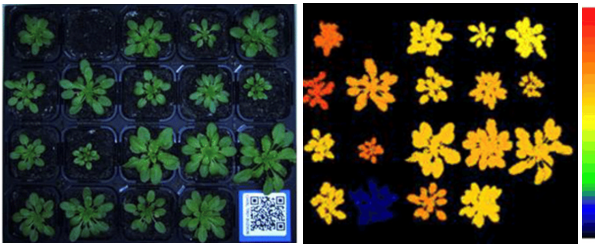
Because herbicide resistance threats crop yield and food security, there are active research programs that are focused on understanding the mechanisms that lead to resistance. This research is performed in an effort to predict which novel pesticides are least likely to be rendered ineffective as a result of future resistance. This research is conducted globally in varied settings: academia, government, and industry. One technique that researchers use to screen for weed resistance is called chlorophyll fluorescence imaging. This technique is non-invasive (can be used on living plants) and a rapid assay to monitor resistance in hundreds of plants a day. Briefly, this technique measures if photosynthesis is inhibited, and can discern photosynthetic injury days before plants are visibly harmed by a Group 5 herbicide. For example, in the image below on the left, weeds could have been sprayed with a Group 5 herbicide, such as atrazine; they all appear green and photosynthetically active. However, the image on the right reveals a different story. This screening technique uses false coloring to depict photosynthesis (red represents highly active photosynthesis, and blue depicts no photosynthesis). Only one of these plants appears blue and has been harmed by atrazine, whereas the other individuals have evolved mutations that rendered them resistant to the herbicide, which allows these plants to be photosynthetically active.
Examples of chlorophyll fluorescence imaging in plants. Image is courtesy of weedscience.org.
Enforcement Reminder
BPC would like to remind everyone that adjuvants, such as surfactants, are pesticides in Maine. Adjuvants must be registered with the state before they can be sold or distributed. Additionally, distributors of adjuvants must have a General Use Pesticide Distributor’s license. Failure to follow these regulations could lead to enforcement action for users of unregistered adjuvants, and marketplaces that sell unregistered adjuvants could have the products pulled from shelves and a Stop Sale, Use, or Removal Order (SSURO) issued for these products until they are registered.
The 130th Maine Legislature passed LD 2019 (PL 2022 c. 673) which defines adjuvants as pesticides in statute (Title 7 Section 604). This law required the Board of Pesticides Control to register adjuvants, which means any wetting agent, spreading agent, sticker, deposit builder, adhesive, emulsifying agent, deflocculating agent, water modifier or similar agent that is intended to be used with any other pesticide as an aid to the application or the effect of it and that is in a package or container separate from that of the other pesticide.
EPA Announces Final Registration of New Pesticide Isocycloseram
Released November 20, 2025
Today, the U.S. Environmental Protection Agency (EPA) registered ten products containing the new active ingredient isocycloseram, a broad-spectrum contact insecticide proposed for use on agricultural crops, turf and ornamentals, as well as indoor and outdoor uses for commercial, industrial and domestic sites. This new active ingredient will give farmers an additional tool to help manage crops and grow more food for our country. Some of the target pests for these products can cause significant crop damage and financial loss to growers, such as the tarnished plant bug in cotton, Colorado potato beetle in potatoes and diamondback moth in Brassica vegetables. Isocycloseram will also give citrus farmers an important new product to help control the pest Asian citrus psyllid, the primary vector of devastating citrus greening disease. Additionally, this pesticide has important benefits for managing indoor pests, including cockroaches, termites and bed bugs. No human health risks of concern were identified when isocycloseram is used according to the registered labels.
The isocycloseram registrations are supported by human health and ecological risk assessments as well as a biological evaluation under the Endangered Species Act (ESA). EPA did not identify risks of concern for aquatic and terrestrial plants. EPA preliminarily concluded that the proposed use of isocycloseram may affect insect pollinators from spray application and aquatic invertebrates from spray, seed and soil treatments. It can also cause chronic risks to birds and mammals ingesting treated rapeseed.
The following mitigation measures are found on the products’ labeling to address on- and off-field effects to non-target species, including listed species:
A link to the Bulletins Live! Two web system, with instructions to follow any applicable endangered species bulletins and Pesticide Use Limitation Areas (PULAs) on the site;
A link to EPA’s mitigation menu where users can choose mitigation options to meet use-dependent point thresholds;
Restrictions for application during rain or when soils are saturated;
Prohibition of aerial application on all uses except corn, cotton, potato and soybean, with additional geographical restrictions included in the label for aerial application on corn and soybean;
Spray drift buffer requirement for aerial, ground and airblast applications;
Prohibition on applications three days before and during bloom for orchard crops;
Prohibition on applications during hours of the day when bees are most active for indeterminate blooming crops;
List of best management practices to help reduce the risk to pollinators and to promote the health and habitat of ground-nesting bees;
Advisory requirement to protect pollinators from isocycloseram-treated seed coating dust; and
Instructions for managing spilled or exposed treated seeds.
With these mitigation measures and Bulletins with associated PULAs for seven listed species in place, EPA’s final biological evaluation predicts that the use of isocycloseram will not result in a likelihood of future jeopardy for the survival of any listed species, or a likelihood of adverse modification for any designated critical habitat.
EPA has initiated ESA consultation and shared its findings with the U.S. Fish and Wildlife Service and the National Marine Fisheries Service (collectively referred to as the Services). During formal consultation, the Services use the information in EPA’s final biological evaluation to inform their biological opinions. While EPA has made predictions about the potential likelihood of future jeopardy/adverse modification as part of its biological evaluation, the Services are responsible for making the actual final jeopardy/adverse modification findings and have the sole authority to do so. If the Services determine in their final biological opinions that additional mitigations are necessary to address any jeopardy/adverse modification determination or to address any unintentional harm known as incidental take, then EPA will work with the registrant to ensure that any necessary registration or labeling changes are made.
Isocycloseram is a pesticide that contains a fluorinated carbon. Visit our webpage to learn more about how EPA ensures the safety of pesticides with a fluorinated carbon.
EPA Registers New Pesticide Active Ingredient Cyclobutrifluram
Released November 5, 2025
Today, the U.S. Environmental Protection Agency (EPA) released its final registration decision for products containing the new nematicide/fungicide active ingredient cyclobutrifluram for use on turf, ornamentals, and romaine lettuce, as well as cotton and soybean seed. No human health risks of concern were identified when this pesticide is used according to the label. Additionally, with the mitigation measures EPA has put in place, the use of this pesticide will not impact endangered species. Cyclobutrifluram is also registered for use in Australia, Argentina, and Brazil, and proposed for use in Canada.
Cyclobutrifluram is expected to be a useful addition to Integrated Pest Management (IPM) programs. It can be used in rotation with other nematicides to reduce potential resistance in crops and turf. IPM provides an effective and environmentally sensitive approach to pest control that focuses on pest prevention and using pesticides only as needed. This approach can be applied in response to pest monitoring where alternative nematicide pesticides are applied prior to planting. By incorporating cyclobutrifluram, farmers gain an additional tool to manage crops and increase food production for our country.
EPA has not identified risks to human health in the risk assessment conducted in support of cyclobutrifluram registrations. EPA also conducted an ecological risk assessment and biological evaluation under the Endangered Species Act and has already completed an informal consultation with the U.S. Fish and Wildlife Service (FWS). FWS concurred with EPA’s determination that the uses of cyclobutrifluram being registered are not likely to adversely affect endangered species or critical habitats, and EPA finalized the biological evaluation.
The following label language is found on the products’ label to address on-field effects to non-target species:
Applications to turf using coarse droplets and restriction to prevent exposure to flowering plants.
Instructions to cover or collect spilled seeds.
Cyclobutrifluram is a pesticide that contains a fluorinated carbon. Visit our webpageto learn more about how EPA ensures the safety of pesticides with fluorinated carbons.
EPA Announces Proposed Registration of Herbicide Epyrifenacil
Released November 3, 2025
Today, the U.S. Environmental Protection Agency (EPA) released for public comment its proposed registration decision for two products containing new active ingredient epyrifenacil for use as a pre-plant burndown herbicide for agricultural use in canola, field corn, soybean, wheat, and fallow land (corn, soybean, and wheat), and for non-agricultural use on non-crop areas such as areas around industrial or farm buildings.
The epyrifenacil registrations are supported by human health and ecological risk assessments as well as a biological evaluation under the Endangered Species Act (ESA). No human health risks of concern were identified when epyrifenacil is used according to the label. EPA preliminarily concluded that the proposed use of epyrifenacil products may affect and are likely to adversely affect multiple listed species and designated critical habitats but predicted that there was no jeopardy and adverse modification for any species or critical habitats.
EPA is proposing the following mitigation measures to address on- and off-field effects to non-target species, including listed species:
Implementing spray drift buffers for agricultural uses.
Requiring runoff/erosion mitigation points to reduce aquatic exposure risks.
Restricting application during rain and when soils are saturated or above capacity.
Instructing users to access and follow any applicable endangered species bulletin from the “Bulletins Live Two” web-based system for all additional directions and restrictions.
The proposed final labeling, which has been revised to include additional mitigation measures to address ecological risks, contains all the necessary requirements and restrictions and complies with the requirements of the Federal Insecticide, Fungicide, and Rodenticide Act (FIFRA).
Epyrifenacil is a pesticide that contains a fluorinated carbon. Visit our webpage to learn more about how EPA ensures the safety of pesticides with single fluorinated carbons.
Next Steps
After considering public comments on the proposed registration decision, the draft risk assessments and the draft effects determinations, EPA will decide whether the registration action meets the standard for registration under FIFRA. If EPA determines that the registration action can be granted, EPA will finalize the biological evaluation. If a final biological evaluation finds that epyrifenacil may affect any listed species or critical habitats, then EPA will initiate ESA consultation and share its findings with the U.S. Fish and Wildlife Service or the National Marine Fisheries Service (collectively referred to as the Services), as appropriate.
During formal consultation, the Services use the information in EPA’s final biological evaluation to inform their biological opinions. While EPA has made predictions about the likelihood of jeopardy and adverse modification as part of its biological evaluation, the Services are responsible for making the final jeopardy/adverse modification findings and have the sole authority to do so. If the Services determine in their final biological opinions that additional mitigations are necessary to address any jeopardy or adverse modification determination or to address any incidental take, then EPA will work with the registrant to ensure that any necessary registration or labeling changes are made.
To read more about the proposed registration of epyrifenacil and to comment, see docket ID EPA-HQ-OPP-2022-0354 at www.regulations.gov. The public comment period will be open for 30 days, closing on Dec. 3, 2025.
Maine State Government is an equal opportunity provider and employer.